
Dr. Ragatz Resources
ENGLISH/LANGUAGE ARTS
GAMES

Many Middle School and High School classes watch CNN 10 as part of their daily routine. Here’s Dr. Ragatz’ second collection of activities to be done at the end of a week of listening to news stories. They are designed to be completed with a partner and vary in length from 10 to 30 minutes.
Activity 1 – Social Media Square
Activity 2 – Words Have Power
Activity 3 – Tableau Vivant
Activity 4 – Jump Rope Chant
Activity 5 – Acrostic Poem

This activity is a team building activity similar to the escape rooms. It can be done in one large room or a combination of inside a classroom and outside. If multiple classes are involved, more space will be needed so that there can be duplicates of the same station.
If Classcraft is used as a classroom management system, the teams and rolls align with it.
Each team must have at least one person as each role. If there are more than one, they must work together or each complete the task.
For added fun, each team member will decorate an item to wear during the quest.
• Mage: felt mask
• Warrior: cloth armband
• Healer: foam bracelet
Each team will compete to be the first to complete the quest and get to the treasure. There will be 5 tasks to complete along the way:
1. Outside the door: a math puzzle (magic square) to “open the door and enter”
2. Tangrams: Mages describe an object so their team can reconstruct 2 tangram puzzles
3. Charades: Healers are under a spell and cannot speak, they must use charades to get their team to say the magic word to unlock the spell
4. Assisted Reach: Warriors must reach an object without stepping out of the circle with the help of their team. The team must work together to achieve this feat. Each warrior on the team must complete this separately.
5. Team works together to solve the riddle. One word in the answer will open the lock on the treasure chest.
Time: 60-90 minutes
This works best in groups of 3-5. Some extra supplies and prep needed for this activity. Most can be kept for future use.

Kids love games and making one is a lot of fun. Let your students design a game as a culminating activity for your next book study, math unit, or at the end of the quarter to wrap up all you’ve covered. This unit includes all you need to get started designing games in your classroom.
Includes:
– Directions for Teachers
– Instructions for Students
– Student Progress Tracking Sheets (for pairs or trios)
– Specific Game Design Instructions for:
– A Novel/Book Report
– Math Concepts
– Science Topics
– Social Studies Topics
– Game Grade Sheets
– Game Play Critique Sheets
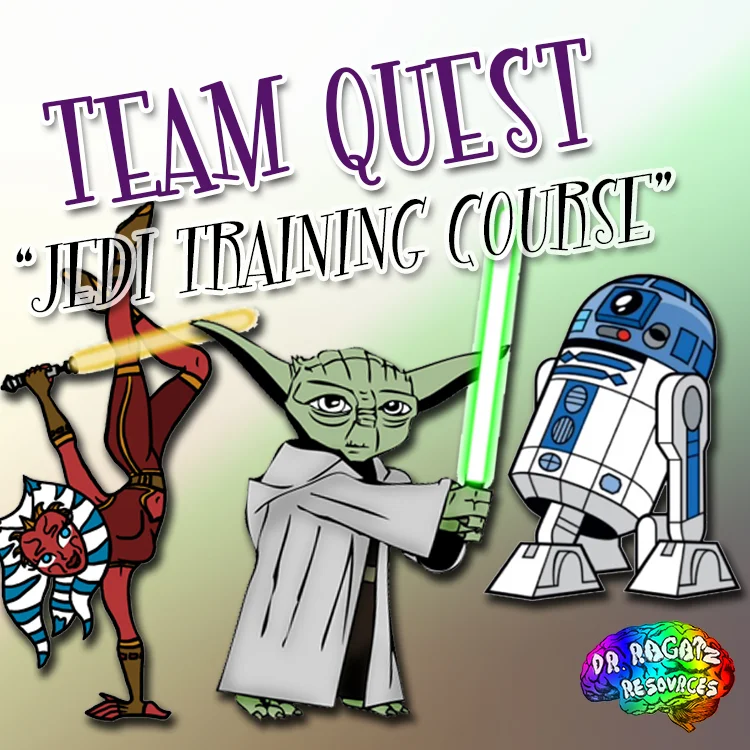
This activity is a team building activity meant to be completed outside or in a large gym. Bring Star Wars to life with this Jedi themed group building activity!
Time:
• Set-up: about 20 minutes, additional adults or older students are needed to run each station.
• Activity: 60-75 minutes
This works best in groups of 3-5.
• Each team must have at least one person as each role. If there are more than one, they must work together or each complete the task.
o Mage
o Healer
o Warrior
• If Classcraft is used as a classroom management system, the teams and roles align with it.
• Each team will compete to be the first to complete the quest and get to the treasure.
• There will be 7 tasks to complete along the way.
• Teams will complete stations #1-6 in different order but all will end at #7.
• Each class (mage, warrior, and healer) has a specific task to complete. These tasks must be completed by all of that class on the team. If there are multiple stations for these tasks, the participants from one team must complete them one at a time.
• There are 4 team events. All team members must participate together to complete these.
• The treasure box is filled with items for each participant (candy or something else appropriate.) Have a variety and a few extra. The first team finished gets the best selection, and so on down, but everyone gets something otherwise there isn’t a lot of motivation to complete the quest.
• If you use ClassCraft, you can also give XP for the winning team as well as other awards such as teamwork, spirit, etc.
Materials Needed:
• check off sheet, 1 per team (on a clipboard is easiest)
• 50-100 piece puzzles – 1 per team Decide on a 5 letter word (ex: wrath) that will work with the letter choices. The letters need to be randomly written on the back of puzzle pieces.
• rope tied in a circle – 1 per team
• blindfolds – 1 per person – These are for one station, so the number needed is only for the largest team. If this station is doubled, twice as many.
• ball/scoop sets – 3 balls
• 3 plastic hoops to toss
• 1 light saber (or pool noodle)
• Hula hoop
• Bamboo stick (the type used for plant stake)
• Bowls, spoon, 8 marshmallows
• Treasure box with 5 letter word lock
• Cones to mark off areas for obstacles course and stations
• Prizes for treasure box
Steps for the project:
• Gather all the materials, many you will have in your classroom or can be borrowed from the PE teacher
• Print task card, 1 per station, teams read them and give them back to the volunteer (Jedi Master) running that activity
This activity is best done when spreading rumors has come up as an issue among the class, grade level or student population at large.
Time: 45-60 minutes
Additional Materials Needed:
• Large paper – 1 per team/group
• Mr. Peabody’s Apples by Madonna

There are many ideas for book report projects that are generic and can be adapted to any type of book. This is not the point of these fifteen projects. These projects get to the heart of what makes each genre of book unique, both fiction and non-fiction, and design specific projects that highlight those qualities. Each project has been carefully selected to get students to think critically about that specific genre of book and what makes it different from the others. Students will analyze traits found in that particular style of writing and employ them in their execution of the project in some way. These projects align with Common Core as they include both fiction and non-fiction. Student must delve deeper into the text and provide support.
Non-Fiction Genres included:
Animal
Biography
Foreign Country
How To
Magazine Article
Sport (2 different projects)
U.S. State
Fiction Genres included:
Newberry Award
Fantasy (2 different projects)
Historical Fiction
Humorous
Mystery (2 different projects)
Poetry
Grade Level:
These projects are appropriate to use with students in grades 3 through 8. Since that is a wide range, for each assignment, there is a space for the teacher to fill in the number of pages required for the book that would be appropriate for the class being taught. Teachers could also assign other types of levels to books if they use them in their classrooms, such as AR or Lexile reading levels.
Rubrics:
Many teachers use rubrics for grading and these have been provided for each project. They can be used to grade the end product, or for students to use as a guideline so that they know what the expectations are for success. The rubrics are designed a little differently than most, as descriptors have only been written for the 1, 3 and 5 on the 5 point scale. This was done to leave the teacher a little “wiggle room”, the 2 and 4 is what is in between in the description and can be left somewhat subjective.
Worksheets:
Most of these projects can stand alone for the culmination as a reading assignment. A few of them also have an additional worksheet to accompany them, if more information is desired.
Teachers can also add an additional writing component to go with any of these projects although at the completion of the project, the teacher can tell if the student understands the material read and additional assignment is not necessary.
Many students are coming to school with a deficit in the Executive Functions skills. These are now another area teachers must be equipped to teach so that students can be successful. These lessons include the most common areas of Executive Function where students need guidance. They can be used individually or as a unit. Each lesson is independent, so they can be taught in any order. Each contains a short YouTube link focusing on the concept. Lessons include individual or group responses.
Lesson topics:
Organization
2 worksheets to complete, team or individual
Planning
Worksheet to complete, individually
Procrastination
Teams create a graphic organizer using the video and applying their own lives.
Task Initiative
Teams create a skit about a task. Teacher will need to come up with ideas for task that relate to his/her students. Ex: cleaning bedroom, book report, homework etc.
Time Management
Worksheet to complete individually.
This game helps students practice the vocabulary associated with learning about literary elements. This is the familiar game memory matching terms and definitions of literary devices and other parts of literature. This is a fun way for students to practice vocabulary with minimal prep time for the teacher.
Word List:
alliteration
falling action
genre
narrator
setting
antagonist
fiction
imagery
non-fiction
simile
climax
figurative language
introduction
personification
static
conflict
first person
literary devices
plot
theme
denouement
flashback
metaphor
protagonist
third person
dynamic
foreshadow
mood
rising action
third person omniscient
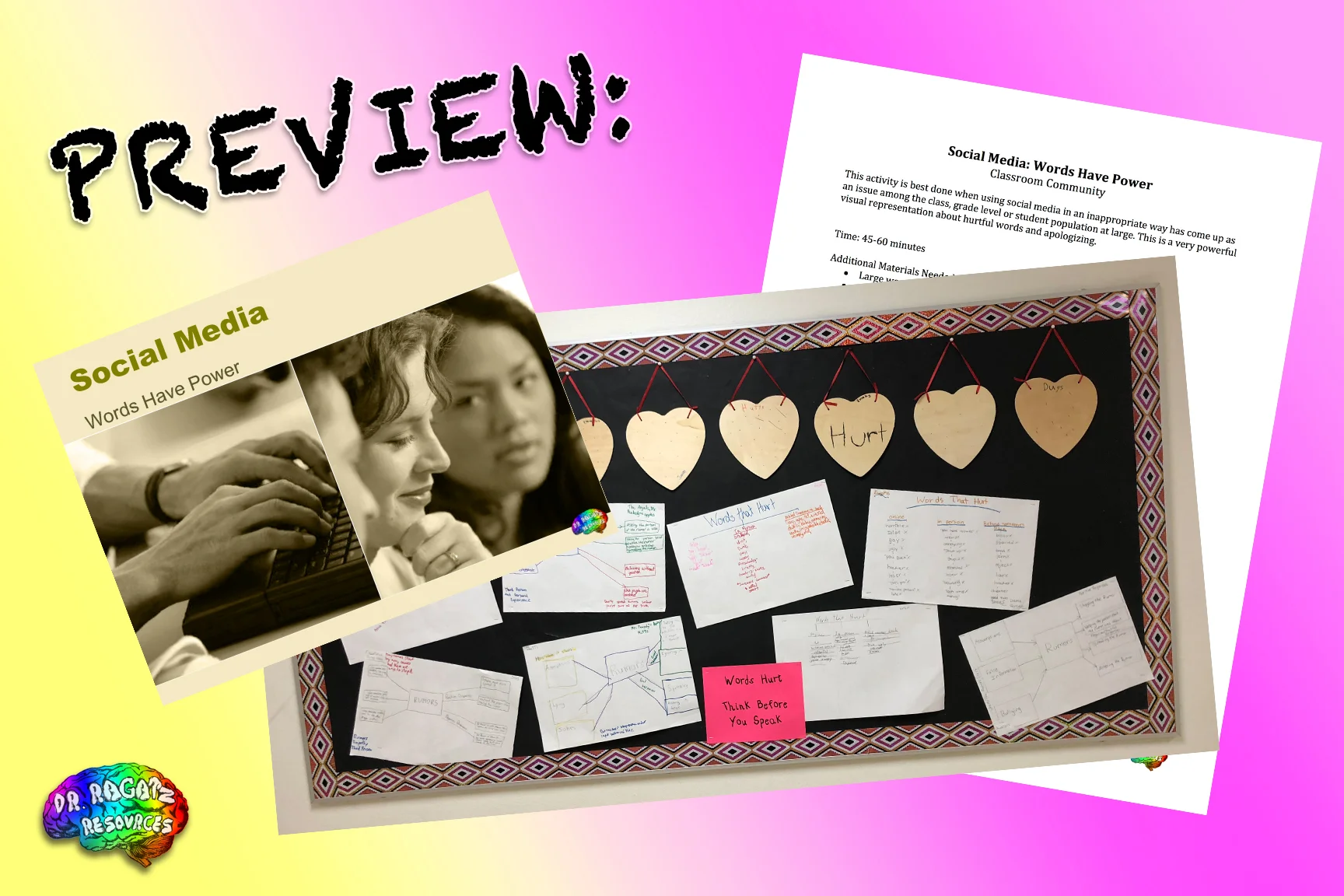
This activity is best done when using social media in an inappropriate way has come up as an issue among the class, grade level or student population at large. This is a very powerful visual representation about hurtful words and apologizing.
Time: 45-60 minutes
Additional Materials Needed:
• Large wooden heart (8-12 inches) – 1 per team/group
• Nails (1-2 inches long, large head) – each group will need 10-20
• Hammers – 1 per group
or
• Paper heart – (8-12 inches) – 1 per team/group
• Push pins/thumbtacks – each group will need 10-20

This activity is a fun way to include factual research about a specific time period with fictional writing. It is helpful to bring in some brochures so students can get an idea of what these look like. One place these can be found is on racks in hotel lobbies.
This assignment is designed to be done on the computer. Templates for brochures can be found in Microsoft Word and Publisher, as well as online.
Brochures could also be completed on construction paper with students drawing the pictures and writing or typing the paragraphs.
Ideas for use:
Social Studies, any specific time period:
· Ancient Civilizations: China, India, Egypt, Greece, Rome
· Historical Periods: Colonial America, Industrial Revolution, WWII
· Specific Places: State, Foreign Country
Literature:
· Fictional setting from a novel. The biography would be the protagonist or antagonist.
Science:
· A specific Habitat or planet. Biography could be a researcher in that field or an animal in that habitat.
Includes direction sheet for students and grading sheet.

Setting concepts to music is a great way for students to review and solidify their learning. Plus it’s a lot of fun!
This project is best in a short time-line to keep students focused. 1-2 days for writing and practice and 1-2 for performances, depending on how long the class time is and how many groups there are.
This works best in groups of 3-5.
General steps for the project:
• Pick a song to change the words to. Here are a couple of different options for choosing songs. One option can be used or a mixture, depending on the student level and classroom policies.
o Allow students to use devices to select popular songs that have a karaoke version so that this can be played when they perform. Older students especially enjoy this.
• Write a song that teaches about cells and their parts.
• Practice it until everyone knows it by heart
• Perform it for the class. You can add movement, props or costumes (bring these in) to improve your overall presentation.
Rubric
Many teachers use rubrics for grading and these have been provided for each project. They can be used to grade the end product, or for students to use as a guideline so that they know what the expectations are for success. The rubrics are designed a little differently than most, as descriptors have only been written for the 1, 3 and 5 on the 5 point scale. This was done to leave the teacher a little “wiggle room”, the 2 and 4 is what is in between in the description and can be left somewhat subjective.

The people of Colonial America liked to read the writings of Ben Franklin. He published a book called Poor Richard’s Almanac in 1732, which ran for 25 years. He said that he “endeavored to make it both entertaining and useful.” What he wrote in his books was not original, but things he found in other sources.
Students can work individually or in pairs to create posters of Ben Franklin’s famous quotes. Teachers can have a list and students may pick from it or be randomly assigned each phrase. Older students can research and find the phrases themselves. It is best if they sign up for their phrase so that you don’t end up with a bunch of the same ones.
Use the Internet or copies of Poor Richard’s Almanac
Search Ben Franklin quotes: both these sites have extensive lists
– goodreads.com
– ushistory.org
Assignment Variation:
Older students: Use the computer to create a meme with one of the quotes.
Rubrics
Many teachers use rubrics for grading and these have been provided for this project. They can be used to grade the end product, or for students to use as a guideline so that they know what the expectations are for success. The rubrics are designed a little differently than most, as descriptors have only been written for the 1, 3 and 5 on the 5 point scale. This was done to leave the teacher a little “wiggle room”, the 2 and 4 is what is in between in the description and can be left somewhat subjective.

This is a fictional, narrative writing assignment focusing on understanding perspectives in stories.
Outside Materials Needed:
Movie: Hoodwinked (2005) animated, rated PG
Book: The True Story of the Three Little Pigs by Jon Scieszka (1996)
1. Watch segments of the movie Hoodwink: Beginning, Red, Wolf, Granny or watch the entire movie and stop after each of these sections to complete the chart.
• The movie runs 80 min. so it is best to do this part over a couple days.
2. Stop and fill out each section of the chart in between
• There are two different options to be used for this. You can use one or both.
• An answer sheet has been included for this. This is just a suggestions, you and your class can make different selections for the plot points.
3. Read The True Story of the Three Little Pigs, discuss perspective
4. Brainstorm Fairy Tale titles and who the different characters are and the different perspective each could be told from.
5. Have copies of pictures books of different fairy tales for the students to read or copies from the Internet, otherwise you will get all the same stories.
• Grimm’s Fairy Tales: cs.cmu.edu (warning, not the “Disney” version)
• A collections of many different types: storynory.com
• International Fairy Tales: fairytalesoftheworld.com
6. Need 3-5 class periods for this assignment depending on writing speed of students and if they work on it at home. Step 6 & 7 (on the PowerPoint) could be put into a book instead.
Rubric
Many teachers use rubrics for grading and these have been provided for each project. They can be used to grade the end product, or for students to use as a guideline so that they know what the expectations are for success. The rubrics are designed a little differently than most, as descriptors have only been written for the 1, 3 and 5 on the 5 point scale. This was done to leave the teacher a little “wiggle room”, the 2 and 4 is what is in between in the description and can be left somewhat subjective.

There are many ideas for book report projects that are generic and can be adapted to any type of book. This is not the point of these fiction projects. These projects get to the heart of what makes each genre of book unique, both fiction and non-fiction, and design specific projects that highlight those qualities. Each project has been carefully selected to get students to think critically about that specific genre of book and what makes it different from the others. Students will analyze traits found in that particular style of writing and employ them in their execution of the project in some way. These projects align with Common Core as they include both fiction and non-fiction. Student must delve deeper into the text and provide support.
Fiction Genres included:
Newberry Award
Fantasy (2 different projects)
Historical Fiction
Humorous
Mystery (2 different projects)
Poetry
Grade Level:
These projects are appropriate to use with students in grades 3 through 8. Since that is a wide range, for each assignment, there is a space for the teacher to fill in the number of pages required for the book that would be appropriate for the class being taught. Teachers could also assign other types of levels to books if they use them in their classrooms, such as AR or Lexile reading levels.
Rubrics:
Many teachers use rubrics for grading and these have been provided for each project. They can be used to grade the end product, or for students to use as a guideline so that they know what the expectations are for success. The rubrics are designed a little differently than most, as descriptors have only been written for the 1, 3 and 5 on the 5 point scale. This was done to leave the teacher a little “wiggle room”, the 2 and 4 is what is in between in the description and can be left somewhat subjective.
Worksheets:
Most of these projects can stand alone for the culmination as a reading assignment. A few of them also have an additional worksheet to accompany them, if more information is desired.
Teachers can also add an additional writing component to go with any of these projects although at the completion of the project, the teacher can tell if the student understands the material read and additional assignment is not necessary.
Kids love games and making one is a lot of fun. Have students design a game as a culminating activity for your next math unit, or even as an end-of-quarter project. This unit includes all you need for game design in your classroom.
Includes:
Instruction PowerPoint
Student Progress Tracking Sheet (groups of 2 or 3)
Game Design Instructions for:
– Math
Game Grade Sheet
Game Play Critique Sheet

Many Middle School and High School classes watch CNN 10 (formerly Student News) as part of their daily routine. Here is a collection of five activities to be done at the end of a week of listening to news stories.
They are designed to be completed with a partner and vary in length from 10 to 30 minutes.
Activity 1 – Current Couplets
Activity 2 – CNN Inferences
Activity 3 – Three, Two, One… News
Activity 4 – 3D Summary
Activity 5 – Slap Me A Current Event

This is a group or individual project to summarize and compare information about the 13 American Colonies. Each group needs a large poster board for the final project.
Rubric
Many teachers use rubrics for grading and these have been provided for each project. They can be used to grade the end product, or for students to use as a guideline so that they know what the expectations are for success. The rubric is designed a little differently than most, as descriptors have only been written for the 1, 3 and 5 on the 5 point scale. This was done to leave the teacher a little “wiggle room”, the 2 and 4 is what is in between in the description and can be left somewhat subjective.
Grade Sheet
Also included is a grade sheet using points, which some teachers prefer to use. Each section is graded separately and paragraphs are broken down into 10 point chunks for easy calculating. There is one map, but each section has separate points.

There are many ideas for book report projects that are generic and can be adapted to any type of book. This is not the point of these non-fiction projects. These projects get to the heart of what makes each genre of book unique, both fiction and non-fiction, and design specific projects that highlight those qualities. Each project has been carefully selected to get students to think critically about that specific genre of book and what makes it different from the others. Students will analyze traits found in that particular style of writing and employ them in their execution of the project in some way. These projects align with Common Core as they include both fiction and non-fiction. Student must delve deeper into the text and provide support.
Non-Fiction Genres included:
Animal
Biography
Foreign Country
How To
Magazine Article
Sport (2 different projects)
U.S. State
Grade Level:
These projects are appropriate to use with students in grades 3 through 8. Since that is a wide range, for each assignment, there is a space for the teacher to fill in the number of pages required for the book that would be appropriate for the class being taught. Teachers could also assign other types of levels to books if they use them in their classrooms, such as AR or Lexile reading levels.
Rubrics:
Many teachers use rubrics for grading and these have been provided for each project. They can be used to grade the end product, or for students to use as a guideline so that they know what the expectations are for success. The rubrics are designed a little differently than most, as descriptors have only been written for the 1, 3 and 5 on the 5 point scale. This was done to leave the teacher a little “wiggle room”, the 2 and 4 is what is in between in the description and can be left somewhat subjective.
Worksheets:
Most of these projects can stand alone for the culmination as a reading assignment. A few of them also have an additional worksheet to accompany them, if more information is desired.
Teachers can also add an additional writing component to go with any of these projects although at the completion of the project, the teacher can tell if the student understands the material read and additional assignment is not necessary.

Time for older students to revisit or newly experience the beloved Dr. Seuss books! Students learn the elements of a book critique and practice writing some, using simple and familiar books.
The final product is a poster of one of the books. These posters are a great display in a classroom or library!
Fun activity designed for Read Across America week, but can be used at any time of year!

Once students know the basic story elements, they can write their own creative narrative. Use this Story Map Graphic Organizer so students can plan before launching into writing. More fun than a basic outline, it reinforces the terms: protagonist, antagonist, setting, problem, rising action, climax, and resolution.

This is a fun, energetic activity to review information form any subject.
Teachers need a playlist of music or use YouTube and select clean songs. Skip to a new song after each stop or use the same song. If you do this in the classroom, be sure to have them push in chairs to create pathways. If you have a way to take music outdoors, it is can be done there as well. The music is key for added engagement.
Uses:
• Introductions at the beginning of the school year.
• Reviewing a textbook chapter read.
• Reviewing concepts before a test.
• Quizzing each other – students use questions and answers instead of facts.

his game helps students practice editing and parts of speech. Editing is a drudgery that students avoid. Here is a game for practicing it in a fun and competitive way. In teams of four, students race to make the most changes to a given sentence. Incorporate vocabulary lists for added challenge. Who knew editing could be so much fun!
Kids love games and making one is a lot of fun. Have students design a game as a culminating activity for your next social studies unit, or even as an end-of-quarter project. This unit includes all you need for game design in your classroom.
Includes:
Instruction PowerPoint
Student Progress Tracking Sheet (groups of 2 or 3)
Game Design Instructions for:
– Social Studies
Game Grade Sheet
Game Play Critique Sheet
Kids love games and making one is a lot of fun. Have students design a game as a culminating activity for your next science unit, or even as an end-of-quarter project. This unit includes all you need for game design in your classroom.
Includes:
Instruction PowerPoint
Student Progress Tracking Sheet (groups of 2 or 3)
Game Design Instructions for:
– Science
Game Grade Sheet
Game Play Critique Sheet

Kids love games and making one is a lot of fun. Have students design a game as a culminating activity for your next social studies unit, or even as an end-of-quarter project. This unit includes all you need for game design in your classroom.
Includes:
Instruction PowerPoint
Student Progress Tracking Sheet (groups of 2 or 3)
Game Design Instructions for:
– Social Studies
Game Grade Sheet
Game Play Critique Sheet

This activity is a fun way to include factual research about a specific time period with fictional writing. Students write a first person essay as a character type/person from history telling about his/her life during that time in the past. Essay must include factual information and show creativity. Paper doll is dressed to depict the fictional person.
In the American History Bundle, the following time periods are covered:
– Colonial America
– Westward Expansion
– American Civil War
– 19th & Early 20th Century
– WWII
The bundle also includes a printable doll template, as well as grade sheets and rubrics.

This game helps students practice using exponents in fun way. Students need an understanding of how to multiply and divide numbers with exponents

This game helps students practice using the vocabulary words that they are learning. Often students memorize words and meanings but cannot use them in their own writing. This game is a fun way for students to practice using the new words they are learning. Since the interrogative (who, what, where, when, why, and how) are randomly rolled on a die, students must also practice forming different types of sentences. All sentences must be grammatically correct to receive a point; other players must listen, analyze and determine if the sentences make sense. This game has the potential to be used in foreign language classes as well. The teacher would have to translate the interrogatives. Add a little competition and vocabulary becomes exciting!

This activity is a fun way to include factual research about a specific time period with fictional writing. Students write a first person essay as a character type/person from history telling about his/her life during that time in the past. Essay must include factual information and show creativity. Paper doll is dressed to depict the fictional person.
In the Ancient Civilizations Bundle, the following time periods are covered:
– Ancient China
– Ancient Egypt
– Ancient Greece
– Ancient Rome
– Medieval Europe
The bundle also includes a printable doll template, as well as grade sheets and rubrics.
Transform your classroom into an Ancient Roman town! Students form groups in order to establish and develop their own town, connected to the Roman Empire. Each student receives a role which guides their research and learning, as well as individual and team tasks.
This simulation contains fifteen days worth of guided activities, complete with presentation slides and audio. For the final day, students present their town models, chariots, and costumes during the culminating Market Day –– a great time to invite parents and others!